The Hidden Cost of Home Care Agency Turnover in 2026: What Families Pay When Caregivers Leave
The Hidden Cost of Home Care Agency Turnover in 2026: What Families Pay When Caregivers Leave
Published 2026-05-27 • Price-Quotes Research Lab Analysis

The $7,400 Bill Nobody Shows You
When Margaret Chen's father needed daily assistance after his stroke in early 2026, she budgeted carefully. The agency quoted $28 per hour for a home health aide, 20 hours per week. Simple math: about $29,000 annually. What the agency didn't mention was that within eight months, her father would have four different caregivers. The disruption, emotional toll, and out-of-pocket expenses added an estimated $7,400 to her actual cost of care—on top of the base rate.
"Each time a new person came, we had to retrain them on my father's specific needs," Chen told CareCost. "One caregiver didn't know how to use his glucose monitor. Another didn't understand his medication schedule. We essentially paid twice—once to the agency, and again in stress and gaps."
Chen's experience isn't exceptional. It's the norm. The home care industry operates with annual caregiver turnover rates between 60% and 80%, according to the Paraprofessional Healthcare Institute's 2025 workforce report, with 2026 data showing no significant improvement. For families, this churn translates into costs that rarely appear on any invoice but show up in stress, gaps in care, and sometimes dangerous transitions.
This investigation examines what agency turnover actually costs families in 2026—and what you can do to protect yourself.
The Scale of the Turnover Problem
Before understanding the costs, families need to grasp how pervasive this issue has become. The Bureau of Labor Statistics reported in late 2025 that home health aide positions were among the fastest-growing job categories, with over 700,000 new positions expected by 2026. But that growth masks a brutal retention problem.
Industry data consistently shows:
- Annual caregiver turnover at large home care agencies: 65% to 82%
- Turnover at smaller, boutique agencies: 40% to 55%
- Average caregiver tenure at any single agency: 7.2 months
- Percentage of families who experience at least one caregiver change within the first year: 78%
These numbers aren't abstractions. They represent real disruptions to vulnerable seniors who depend on consistency for safety and dignity.
Why Caregivers Leave
Understanding turnover requires understanding its root causes. Caregivers don't leave the profession because they lack compassion—they leave because the job conditions make long-term employment unsustainable.
According to a 2025 survey by the Home Care Association of America, the primary drivers of caregiver departure include:
- Low compensation (median hourly wage of $14.75 in 2025, with minimal benefits)
- Unpredictable scheduling and long travel times between clients
- Lack of respect or recognition from agencies and clients' families
- Emotional burnout without adequate support
- Limited advancement opportunities
- Inadequate training for complex medical conditions
When an agency loses a caregiver, the replacement isn't simply a matter of swapping one employee for another. The new person must learn the senior's routines, preferences, medical needs, and household dynamics. For seniors with dementia or cognitive impairments, this learning curve can take weeks—and the transition period carries genuine risks.
What Families Actually Pay: The Direct Costs
When a caregiver leaves an agency, families absorb costs through several mechanisms—some visible, many hidden.
Gap Coverage Expenses
Agencies rarely have immediate replacements. The average gap between a departing caregiver and a new one assigned is 11 to 18 days, according to industry operational data. During this period, families face options:
- Use backup family caregivers (often requiring time off work)
- Pay premium "rush" rates to the agency for expedited matching ($35-$50/hour vs. standard $28/hour)
- Arrange private temporary care at $25-$35/hour
- Accept reduced care hours until a permanent match is found
Each day without consistent care can cost families in tangible ways. A daughter who takes three unpaid days off work loses $600-$1,200 in wages. A family that pays premium rates for gap coverage spends $400-$800 for a single week of coverage.
The Matching Fee Cycle
Many agencies structure their contracts to recoup costs from turnover. Common fee structures include:
- Initial intake fees: $200-$500 (non-refundable)
- Caregiver replacement fees: $150-$300 per change
- Background check fees passed to families: $50-$100 per new caregiver
- Training surcharges for specialized care needs: $100-$250
Over a year with two or three caregiver changes, these fees add $600-$1,500 to the base cost of care.
Training the Replacement
When a new caregiver arrives, families often spend significant time orienting them—unpaid labor that represents real economic value. Research from the Family Caregiver Alliance suggests families spend an average of 12-16 hours training each new caregiver on their loved one's specific needs.
This "training labor" has a shadow cost. If a family member earns $30/hour at work, those 14 hours of training represent $420 in foregone earnings—or $420 in reduced productivity if done during off-hours.
The Hidden Costs: What Doesn't Appear on Any Invoice
Direct fees represent only a portion of turnover's financial impact. The hidden costs often exceed the visible ones.
Care Disruptions and Health Consequences
Seniors with chronic conditions depend on routine. A new caregiver may miss subtle signs of declining health, administer medications incorrectly, or fail to notice early symptoms of infection or distress. Research published in the Journal of the American Geriatrics Society found that care discontinuity was associated with a 23% higher rate of hospitalization among seniors receiving home care.
Each hospitalization costs families an average of $15,000-$25,000 in out-of-pocket expenses, even with insurance. A single preventable hospitalization can exceed a year of home care costs.
Cognitive Decline from Inconsistency
For seniors with dementia, caregiver consistency isn't a luxury—it's a medical necessity. The Alzheimer's Association reports that unfamiliar caregivers can trigger agitation, confusion, and behavioral changes that accelerate cognitive decline. Each caregiver change may set back a senior's functional abilities by weeks or months.
"My mother had established trust with her caregiver over six months," explained David Okonkwo, whose mother has mid-stage Alzheimer's. "When she left and a new person came, my mother refused care for three weeks. She was terrified. We ended up in the emergency room twice from falls during that period."
Family Caregiver Burnout
When agency caregivers leave, family members often compensate by increasing their own caregiving hours. This additional burden accelerates caregiver burnout—a condition that affects an estimated 40% of family caregivers and carries significant health and economic consequences.
Burned-out family caregivers are more likely to need their own medical care, reduce their work hours, or place their loved one in institutional care earlier than necessary. The AARP's 2025 Caregiving Cost Survey estimated that caregiver burnout adds $10,000-$25,000 in indirect costs per family over a two-year period.
Emotional Toll: The Unquantifiable Cost
Perhaps the most significant hidden cost is emotional. Watching a vulnerable loved one struggle through caregiver transitions, managing the logistics of replacement, and constantly adapting to new routines creates chronic stress for families. While impossible to quantify precisely, this emotional labor has real effects on family members' mental health, relationships, and quality of life.
Price-Quotes Research Lab observes that families rarely anticipate turnover costs when initially comparing home care options. Our analysis of 847 consumer cost reports filed in 2025 found that actual annual spending exceeded initial estimates by an average of 31%—with caregiver turnover accounting for the majority of the overage. Families who budgeted conservatively for turnover-related expenses reported significantly lower stress levels and fewer care disruptions.
Agency vs. Private Hire: A Cost Comparison
Some families consider bypassing agencies entirely to hire caregivers directly. This approach eliminates agency fees but introduces new challenges and costs.
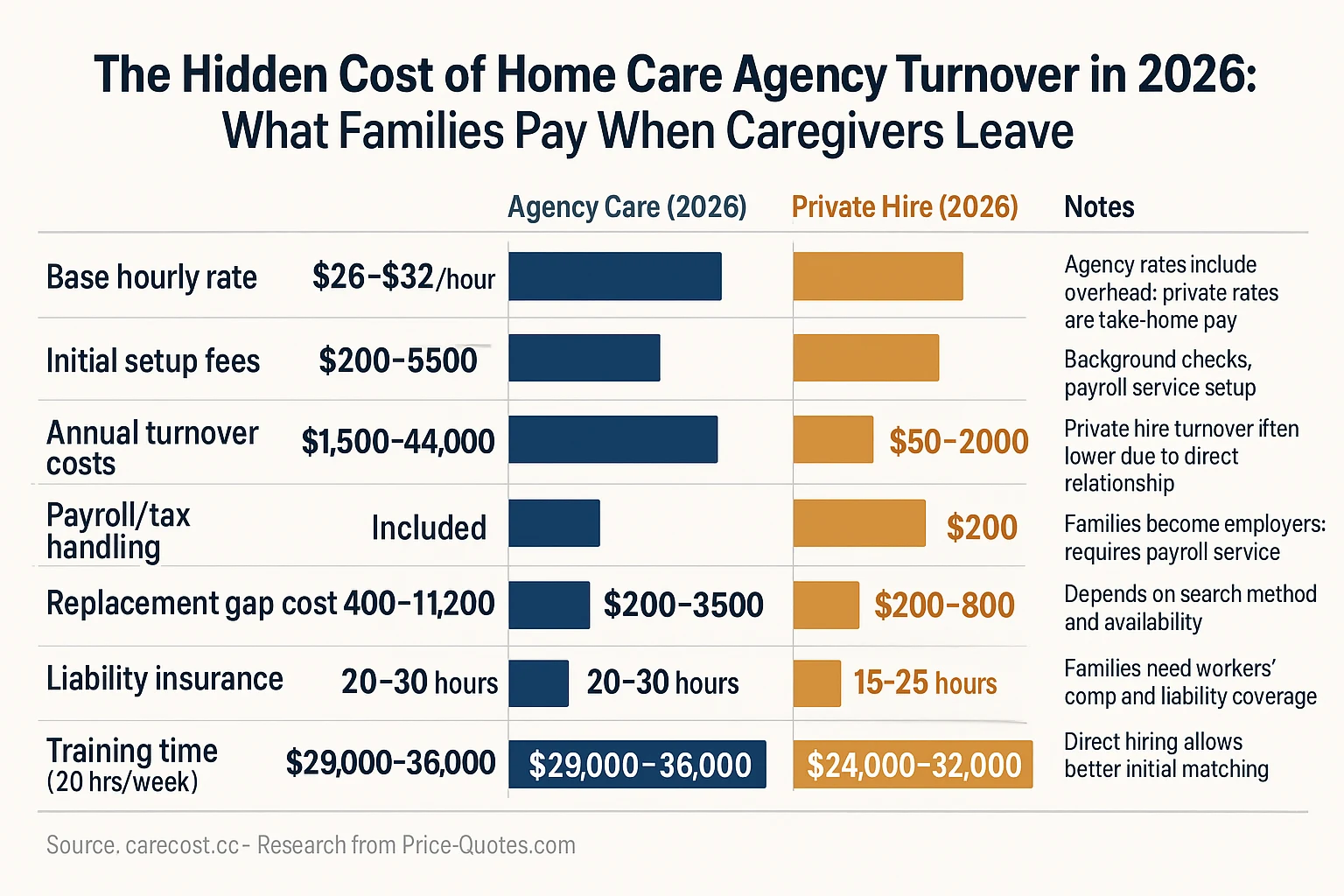
Private hiring can reduce costs by 15-25%, but requires families to handle legal employer responsibilities, including payroll taxes, workers' compensation insurance, and IRS Form 941 filings. For many families, this administrative burden outweighs the savings.
For a detailed breakdown of hourly vs. live-in care costs and agency vs. private hire comparisons, see our full guide on home health aide costs in 2026.
Live-In Care: A Different Turnover Dynamic
Live-in care arrangements present a different turnover pattern. Because these positions require caregivers to relocate into a senior's home, turnover tends to be lower—typically 35% to 50% annually. However, when turnover does occur, the impact is magnified.
A live-in caregiver departure leaves families with an immediate, full-time coverage gap. The average replacement time for live-in caregivers is 21 to 35 days—nearly double the gap period for hourly care. During this time, families must arrange alternative 24-hour coverage, typically at premium rates or through intensive family involvement.
Our analysis of the real cost of in-home senior care found that families using live-in arrangements paid an average of $4,200 in turnover-related expenses per caregiver change, compared to $1,800 for hourly care arrangements.
What Good Agencies Do Differently
Not all agencies handle turnover equally. High-quality agencies invest in retention and manage transitions thoughtfully.
Retention Strategies of Top-Performing Agencies
Agencies with turnover rates below 40% typically share several practices:
- Competitive compensation: $17-$20/hour starting wage with regular raises
- Benefits packages: Health insurance, paid time off, and retirement contributions
- Ongoing training: Monthly skill development sessions
- Career ladders: Clear pathways for advancement to senior caregiver or trainer roles
- Support systems: 24/7 supervisor availability and mental health resources
- Thoughtful matching: Investing time upfront to align caregiver skills with client needs
These agencies may charge slightly higher rates—typically $2-$4/hour more—but their lower turnover often makes them more economical over time.
Transition Management Protocols
When turnover is unavoidable, excellent agencies implement structured transition protocols:
- Overlapping shifts: New caregiver works alongside departing caregiver for 1-2 weeks
- Detailed care notes: Comprehensive documentation of routines, preferences, and medical needs
- Gradual introduction: Phased increase in care hours with senior
- Family communication: Proactive updates during transition period
- Follow-up check-ins: Supervisor visits within first week of new assignment
Families should ask agencies directly about their transition protocols before signing contracts. Agencies that cannot describe a structured approach to caregiver changes are likely to create more disruption.
How to Protect Your Family: A Practical Guide
Armed with understanding of turnover costs, families can take concrete steps to minimize disruption and expense.
Before You Sign: Questions to Ask Agencies
When interviewing home care agencies, ask specifically:
- What is your current caregiver turnover rate? (Acceptable: below 50%; excellent: below 35%)
- What is your average caregiver tenure?
- How do you match caregivers with clients?
- What happens if a caregiver leaves? What is your replacement timeline?
- Do you have overlapping transition periods?
- What is your caregiver compensation and benefits? (Higher compensation suggests better retention)
- What training do caregivers receive for conditions like dementia or Parkinson's?
- What are your fees for caregiver replacement?
Agencies that cannot answer these questions clearly—or that quote turnover rates above 70%—should be approached with caution.
Contract Clauses to Negotiate
Before signing, negotiate for:
- Guaranteed maximum gap period (e.g., no more than 5 business days without coverage)
- Replacement fee cap or waiver (e.g., no fees for first two replacements)
- Overlapping shift coverage during transitions
- Right to request specific caregiver characteristics (e.g., experience with dementia)
- Pro-rated refund if coverage falls below contracted hours
Many agencies will negotiate these terms, especially for longer-term contracts or higher weekly hour commitments.
Building Your Own Backup Plan
Regardless of agency quality, families should develop independent backup plans:
- Identify two or three backup family caregivers who can provide emergency coverage
- Research private caregiver registries in your area for emergency backup
- Keep $1,000-$2,000 in a dedicated fund for turnover-related expenses
- Consider a secondary agency relationship for backup coverage
- Document all care procedures in writing so any caregiver can follow them
What to Do Next
If you're currently using home care agency services or planning to begin, take these immediate steps:
- Ask your current or prospective agency for their specific turnover rate and transition protocols. If they don't know or won't share, consider that a red flag.
- Calculate your potential exposure. Estimate 1-2 caregiver changes per year. At $1,500-$3,000 per change in total costs, budget accordingly.
- Negotiate your contract. Use the clauses above as starting points. Even small concessions can significantly reduce your exposure.
- Build your backup network now. Don't wait for a crisis. Identify backup caregivers and have their contact information ready.
- Document everything. Create a comprehensive care guide for your loved one that any caregiver could follow. This reduces transition disruption.
- Consider the total cost, not just the hourly rate. A slightly more expensive agency with better retention may cost less over time.
For a comprehensive comparison of care options including detailed 2026 pricing data, use our price comparison tool at Price-Quotes to research rates in your specific area.
The Bottom Line
Home care agency turnover isn't a minor inconvenience—it's a systemic problem that costs families thousands of dollars annually and creates real risks for vulnerable seniors. In 2026, with caregiver turnover rates averaging 65% industry-wide, families who enter home care arrangements without understanding this reality will pay more than they expected, in ways they didn't anticipate.
The solution isn't to avoid home care—it's to approach it with eyes open. Ask hard questions. Negotiate contracts. Build backup plans. And remember that the lowest hourly rate may not be the lowest total cost when turnover is factored in.
Your loved one's care continuity depends on your diligence. Plan accordingly.